FIELD NOTES
Can a Camera Work in 50cm of Dutch Canal Water? An Honest Answer
Let's start with the honest answer, because this post is about not lying to you: a typical Dutch canal in August has around 30–80cm of visibility. An underwater camera — any underwater camera, at any price — is going to give you a picture of a 30–80cm sphere of green-brown water. You will not see a 10m-wide view of cruising carp. You will see a fish when it comes within a metre of the lens, and not before.
So why would you bother?
Because that one-metre sphere is still more than you know from the bank. And for certain Dutch canal situations — tight pike ambush zones, marginal carp spots, perch aggregation points — that sphere of vision is exactly what changes your approach.
Why Dutch canals are uniquely murky
The Netherlands is a water-managed country. Most of what Dutch anglers call "canals" are actually polder drainage channels, river connections, or city waterways. They share a few common traits that give them their characteristic visibility:
- Suspended clay particles. Polder water drains through clay-rich soils. Fine particles stay suspended.
- Nutrient load. Agricultural runoff feeds phytoplankton. Green water year-round in many places.
- Boat traffic. Recreational and commercial boats churn bottom sediment continuously in spring and summer.
- Shallow. Most Dutch canals are 1.5–4m deep. Wind alone stirs the bottom.
- Low flow. Unlike a river, sediment doesn't flush — it settles, gets stirred, and re-settles.
The combination means even on a calm morning in May, you're often looking at 60–100cm of visibility. After a weekend of boat traffic and wind, 20–40cm is common. This is not a dramatization — any Dutch angler who's snorkelled or dived in a canal will confirm it.
Where a camera still makes sense on Dutch water
Marginal pike ambush spots
Pike sit tight against reeds, under overhanging trees, and around any structure that breaks the uniform canal geometry. You're casting a dead bait or a lure into a 2m-wide slot of water. A camera dropped into that exact slot tells you whether the slot holds a fish — right now, today, not in theory.
At 50cm visibility, when a 70cm pike enters the frame, you see it clearly. The wide 136° field of the CanFish CamX actually helps here: a narrower lens would miss fish that drift past at the edge of the viz cone.
Carp holding areas
Dutch canal carp have habits. They cruise certain shelves, rest against certain boat hulls, feed in certain dead-end corners. You probably already know three or four of these spots on your home water. A camera lowered for 20 minutes tells you whether carp are present today, without putting bait in and waiting three hours.
For session planning alone, that's valuable — especially for anglers who can only fish once a week and don't want to waste the trip on an empty swim.
Perch aggregations around cover
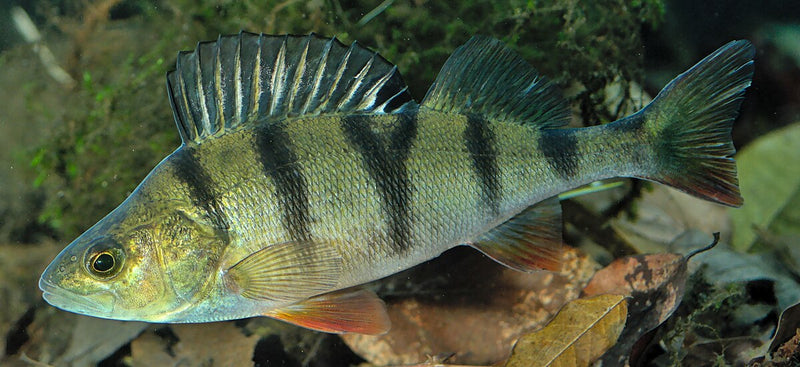
Dutch canal perch school around submerged structure: boat moorings, old piles, collapsed bank reinforcement, sunken bicycles (yes, really). A camera confirms presence and shows you roughly how big the school is. You don't need perfect clarity to count perch at 40cm range.
Bottom reading
Even at 30cm visibility, the camera laid on the bottom tells you exactly what's down there — hard clay, soft silt, leaf litter, weed growth, invertebrate life. Experienced carp anglers use this to find feeding spots that aren't visible from the surface.
Where a Dutch camera genuinely doesn't work
Be honest with yourself before buying:
- Searching unknown water. You cannot drive a camera slowly through a new canal and "scout." You'll see a blur of brown and nothing useful.
- Deep sections (5m+). Light disappears fast in high-turbidity water. Past 3m you're relying on LEDs alone, and the LED range is perhaps 40cm of useful illumination in clay-suspension water.
- After rain. Runoff is measurably worse than baseline. Don't plan a camera session for the day after a storm.
- During bloom season in warm, shallow canals. Late July / August green-water is the worst. Stick to spring and autumn.
Seasonal strategy for Dutch waters
| Month | Typical viz | Camera plan |
|---|---|---|
| January–February | 60–120 cm | Best clarity. Cold water settles particles. Pike and perch. |
| March–April | 50–100 cm | Good. Pre-bloom, pre-spawn perch active. |
| May–June | 40–80 cm | Mixed. Boat traffic increases. Morning sessions. |
| July–August | 20–50 cm | Challenging. Algae peaks. Short-range use only. |
| September–October | 40–80 cm | Recovering. Good pike season begins. |
| November–December | 60–100 cm | Strong. Cold clarity returning. |
If you mostly fish summer evenings on a warm polder, a camera is a luxury purchase, not a strategic one. If you're a year-round angler, the cold-water months are where this tool pays back the spend.
A Rotterdam example
A customer wrote to us from Rotterdam about his local canal — a 3m-deep stretch running between two residential quarters, known for pike, perch, and the occasional carp. He said:
"I used the camera for two months and caught no more fish than I did before. Then I realised that wasn't the point. What changed was I now know which three moorings in my 500m stretch actually hold fish in winter, which are dead, and which only hold fish after wind blows from the south. I stopped fishing the dead spots. My catch rate doubled in February."
That's what a camera does on marginal-visibility water. Not magic. Information. Over weeks and months.
Practical Dutch canal setup
- Attach the camera to a weighted drop line (a 150g lead on a swivel works). The lanyard eyelet on the CamX is robust enough for this.
- Lower it from a bridge, jetty, or bank at a target spot.
- Leave it sitting for 10–20 minutes. Don't jig it. Turbid water amplifies motion blur — keep it still.
- Retrieve, rinse with tap water, review footage at home.
- Don't expect every session to reveal a fish. Many will not.
The 138-minute battery gives you enough runtime for 4–6 spots per session. The 16GB internal storage handles roughly 3–4 hours of 1080p footage. Review it on the phone app or a laptop later. You're looking for context, not highlights.
When to not buy a camera for Dutch waters
If you fish once a month, catch plenty already, and aren't curious about what's below — save your money. This tool rewards the curious and the systematic. It doesn't make casual anglers better.
If you fish two or three times a week, are frustrated by blank sessions, and want to understand your local water in a way a sonar can't give you — it's the right tool, even in turbid Dutch conditions. You'll work within the 50cm sphere and still learn things that change your fishing.
Regional note from Riga
Fisho ships the CanFish CamX to the Netherlands from our Riga warehouse via DPD and Omniva. Delivery to Dutch addresses typically takes 3–5 working days. Price includes EU VAT, and there are no customs charges for shipments inside the EU. If you return the camera within 30 days of receiving it, we refund in full — which is a reasonable safety net if you want to test it on your local canal and see whether the 50cm sphere does anything for your fishing.